
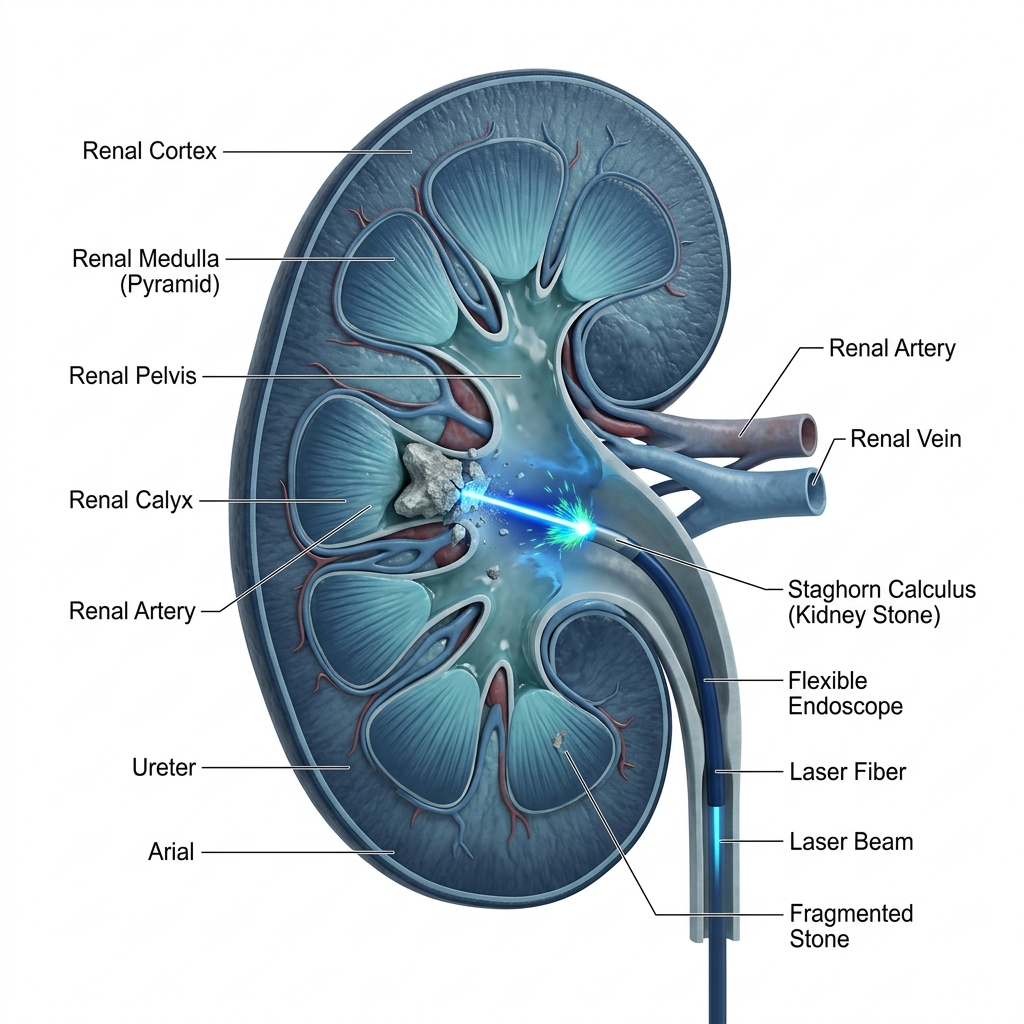
Using Retrograde Intrarenal Surgery Technology, this procedure can also be performed to remove kidney stones, which can be seen through the endoscope and later crushed or blasted using an ultrasound probe or evaporated using a laser probe or could be manually removed using a pair of small forceps.
RETROGRADE INTRARENAL SURGERY (RIRS) & LASER LITHOTRIPSY FOR KIDNEY STONES
Who Performs This Surgery?
A urologist with specialized expertise in RIRS is best suited to performing RIRS.
Retrograde Intrarenal Surgery (RIRS): This procedure refers to surgery done inside the kidney with a viewing tube, better known as a fiber optic endoscope. Due to recent technological strides in this field, it has become possible to implement Retrograde Intrarenal Surgery (RIRS) to manage kidney stones
While surgery can improve symptoms dramatically, TURP can have significant unwanted side effects. You should discuss the pros and cons of both medical management and surgery with your doctor before you make a decision.
- Failed attempts at treatment
- Kidney stones too large for treatment by lithotripsy
- Strictures in the kidney
- Tumors in the kidney
- Kidney stones among children
- Bleeding disorders in the kidneys
- Grossly obese patients
Retrograde Intrarenal Surgery (RIRS): This procedure refers to surgery done inside the kidney with a viewing tube, better known as a fiber optic endoscope. Due to recent technological strides in this field, it has become possible to implement Retrograde Intrarenal Surgery (RIRS) to manage kidney stones.
/div>
How The Surgery Is Performed
Before the procedure
Pre-operative checkups to ascertain the position of the stone the general health condition of the patient and his response to anesthesia will be conducted one or two weeks before the admission for retrograde intrarenal surgery will be done on previous day of the surgery. Pre-operative Dj stenting will be done 2 weeks prior to RIRS surgery. This procedure is generally carried out under general anesthesia. On the day of the surgery, the patient expected to fast for 4-6 hours.
Surgery
Retrograde Intrarenal Surgery techniques are absolutely remarkable. It is performed by a urologist by passing the endoscope through the urethra into the bladder and through the urethra into that part of the kidney where urine is collected. The scope thus is removed at the upward end of the urinary tract system and within the kidney or intra-renal.
This is a novel technique to remove kidney stones. The ureteroscope can easily remove kidney stones of a maximum of 1.5cm in size. When passed into the kidney through the bladder, the kidney stones are identified and blasted using a laser. For the ureteroscope to enter the kidneys easily, the ureteroscopy is first dilated by placing a Dj stent in the affected kidney two weeks before the surgery is performed. This leads to quicker recovery of the patient and he or she can resume their daily lives from the third day after surgery.
This is a novel technique to remove kidney stones. The ureteroscope can easily remove kidney stones of a maximum of 1.5cm in size. When passed into the kidney through the bladder, the kidney stones are identified and blasted using a laser. For the ureteroscope to enter the kidneys easily, the ureteroscopy is first dilated by placing a Dj stent in the affected kidney two weeks before the surgery is performed. This leads to quicker recovery of the patient and he or she can resume their daily lives from the third day after surgery.
Post-Surgery
After completing RIRS, the patient will be taken to the recovery room where he will receive intensive care. A urine catheter will be fitted into the urethra for a day for minimizing the pain and difficulty while urinating.
The patient will be advised bed rest 24 hours after receiving spinal anaesthesia and to drink plenty of water so that 2.5 liters of urine output per day can be maintained and infections kept at bay. However, if the patient is well enough, he or she need not rest but can be discharged the day after surgery. The doctor can ask to see the patient five days after being discharged from hospital.
Advantages of this procedure
Retrograde Intrarenal Surgery for stone extraction is quicker than traditional open surgery. Besides, patients do not experience pain after surgery and overall, they recover much faster. There is also minimal bleeding and the renal tissue is free of damage. This procedure also produces better clearance of kidney stones.
RIRS is being seen as a safe retrograde endoscopic procedure to treat renal calculi. However, if patients have stones larger than 20mm diameter or several small calculi, especially along with pre-existing tubes or after experiencing urinary tract infections, they belong to a small section of patients at high risk for complications and will not get complete satisfaction from RIRS.
If you are facing the symptoms of the Kidney stone and the pain is unbearable then you should have to meet one of the leading urologists Dr. Hiralal Chaudhari and take a Retrograde Intrarenal Surgery (RIRS) which is the Non-invasive procedure for Kidney Stone.